Which .17?
by Jim Saubier
One of the most popular .17 caliber questions is "Which .17 do I need?". What I have tried to do here is provide some guidance when making that decision. I have hands on experience with many of these, and have sought information from others when covering the cartridges that I am less familiar with. I currently load for 5 of these .17s and dont intend to own all of them as they dont all appeal to me. There are several load manuals available that provide information on the .17s and I will cover them in the section called - .17 caliber publications. I am not attempting to provide load data here.
.17 CCM
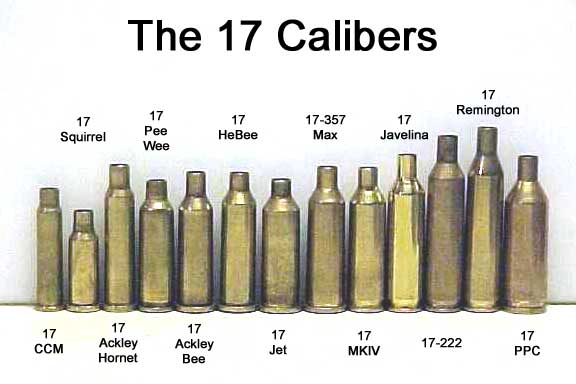
This is the Cooper Centerfire Magnum (CCM) and is the smallest of the reloadable .17s that I am aware of. I have heard of some rimfire .17s, but dont know anything about them. This is a very small case that is based on the .22 CCM case that was intended to be a certerfire case that is reloadable and comparable to the .22WMR. This case was developed by Dan Cooper of Cooper firearms. It should be intended to shoot the lighter .17 bullets with small amounts of powder and create very little noise. Fouling would probably be very limited as well. It should push the 15 grain bullets to close to 3500 fps. This cartridge is covered pretty well in the "Sensational Seventeens" manual that is written by Todd Kindler.
.17 Squirrel
Another cartridge that I dont have any experience with. Load data for this round is provided in Dick Saunders load manual. As the name implies, this is a cartridge that is intended to be used on squirrels and such critters as a reloadable cartridge that will out perform any rimfire. It should be a dandy cartridge indeed for turkeys as well.
.17 Ackley Hornet
I just got a contender barrel chambered for this cartridge and really enjoy shooting it. I hope to write an article on this little gun in the fall/winter timeframe. This is a classic .17 and for good reason. The brass is cheap, the recoil is nil, the powder used is minimal, and the performance is stellar. I have read many articles on this round, and am impressed that it can be used for so much. Vic (one of the Coyote Gods see links page) uses has used his .17 hornet on coyotes. I have heard of others using this round for coyotes as well and most report the same thing. If the range is reasonable and the shot placement correct, they go down like struck by lightning. Load data is available for this case in both .17 load manuals that I have(Kindlers and Saunders). The .17 Ackley hornet should be intended for prairie dogs, squirrels, foxes, woodchucks, and other small critters out to 200 yards.
.17 Ackley Bee
Based on the fine .218 Bee case. The Ackley Bee is a fine cartridge and shows some advantage over the Hornet. Case forming is easy, dies readily available, and load data is available in Dick Saunders manual. My good friend John Delozier is working with an Ackley Bee and he is very pleased with the performance thus far. With the performance being better than the hornet the only advantage that the hornet has is the price of the brass. Bee brass is almost twice the cost of the very economical hornet brass. Availability is not an issue for Bee brass at this time. The Bee brass is thicker and stronger than the hornet brass, and should be able to be reloaded more times. This cartridge is only slightly better than the .17 Ackley Hornet in the velocity department. Thank you Mr. Ackley for another .17.
.17 Hebee
This is nothing more than a .17 Ackley Bee improved. Dennis Hrusosky took notice of the longer neck on the Ackley Bee and must have figured that it would be better with more power RRRRRR. Either way, the only difference is the location of the shoulder. The Hebee gains case capacity and that translates to greater potential velocities. Making cases is not difficult, but annealing is a requirement. This round will come very close to the performance of the .17 Mach IV with the 20 grain bullets, but the Mach IV will handle the 25 grain bullets slightly better. I hope to do a side by side comparison of these two in the near future and will report the results then. Out of a 20 inch barrel, I am able to push a 20 grain V-max or Starke to 3900 fps. That is pretty impressive for such a small cartridge. Loading data for this cartridge is available in Todd Kindlers Sensational Seventeens and also in my article posted on this site.
.17 Mach IV
This is the most popular of the .17 caliber wildcats and for good reason. It is easy to form the cases, load data is readily available, and it is a very efficient performer. This round is based on the .221 Remington Fireball case, and is simply necked down to .17 and loaded. The case looks perfect once it is necked down and hardly changes at all after firing for the first time. The Mach IV as its name implies should be able to push a 25 grain bullet at 4,000 fps. I am not sure that it can safely do this with a barrel shorter than 26", but have heard reports of some doing it. The one that I am beginning to test only has a 20" barrel, and I hope to compare apples to apples with the Hebee and Mach IV soon. The Mach IV can do just about anything that the .17 remington can do with the 25 grain bullets, but the .17 Remington gets the nod when using the heavier 27 - 30 grain bullets.
.17 Javelina
The .17 Javelina is based on the .222 case and has a case capacity between the Mach IV and the .17 Remington. The Javelina has never gained the popularity of the Mach IV or most of the other .17s due to the case forming expense and difficulty. The forming dies for this caliber are expensive. The Javelina case is formed by pushing the shoulder back about 0.150". This is normally done with a forming die set, made by RCBS, Redding, etc. It could also be roughly done with a 221FB full-length die, set higher in the press
than normal. Necking down to 17cal. is then done with subsequent dies. There is significant case trimming that must take place following the forming. I hope to own a Javelina some day and look forward to the challenge of case forming (not the expensive dies though). Kevin Gullette (technical staffer for SCN) is a big fan of this cartridge and has provided the case forming information for the Javelina.
.17-.222
This is similar to the Javelina, but with a little more case capacity. It is also very similar to the .17 Remington. It will have a slightly longer neck than the .17 Remington and should be easily formed from .222 brass by simply necking down the case. The shoulder should remain in its original location. This cartridge has seen limited popularity probably since it is so close to the .17 Remington. With the fine .222 brass out there, this cartridge does not get the attention that it should.
.17 Jet
This caliber was created by Dick Saunders, and a joy it is to shoot. The case forming can be considered tedious, but the effort is rewarded with a fine round. This cartridge is based on the .22 Remington Jet case, with an almost straight taper and 32 degrees shoulder. The case capacity of this round is similar to the Mach IV, but the performance is closer to the .17 Remington or possibly even greater. These cases are thick and strong. Load data on this cartridge is listed in Dick Saunders load manual and nowhere else that I am aware of. Just about any of the powders that are listed for the Mach IV should be good performers. Case availability seems to haunt this little cartridge, but when it is available it is usually very cheap. I have bought 700 Jet cases recently for 13.70 per 100. These cases should last a very long time as well. I only intend to form 300 and want to sit on the rest for other potential projects. I will be doing an article on this gun and have been working with Dick Saunders for this effort.
.17 Remington
The only commercially loaded .17 caliber available. Remington has offered the Model 700 for this caliber for quite a while, and even made it the 1999 Model 700 Classic one of which I have in my safe. This is the workhorse of the .17s, and has gained moderate popularity amongst the fur hunters. With 25 grain bullets, a velocity of 4,000 fps can be safely achieved, and 4300 fps with the 20 grain bullets is certainly attainable as well. Favorite powders for this caliber are IMR4320, Winchester 760, Varget, and Vihtavouri n135. I personally have found favor with IMR 4320 and have used all listed powders with exception of n135. Where the .17 Remington really shines is with the 30 grain bullets. A 1-9 twist is recommended when using the 30 grain bullets, but the .17 Remington can whirl them out there at a pretty good clip.
.17 PPC & .17 BR
Any information on these would be appreciated as I have little. The parent cases are obvious, and I am sure that they are just necked down to .17 but I have little comparison velocity wise of what they are capable.
All rights reserved. Privacy Policy